 The Future of Smartphones: 7 Technologies That Will Change How We Use Our Phones
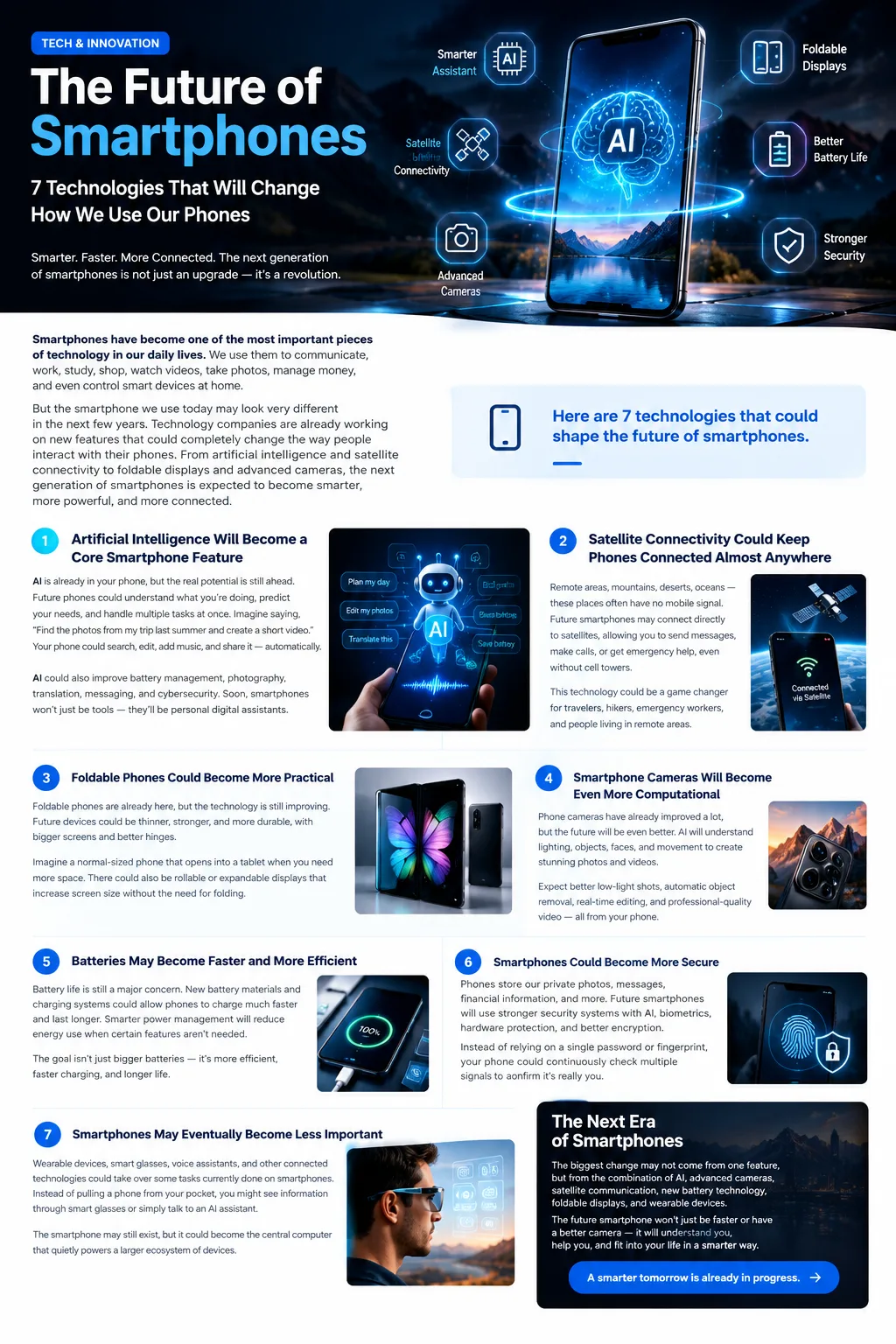
The Future of Smartphones — AI-powered smartphone, satellite connectivity, foldable displays, advanced cameras and future technology
Smartphones have become one of the most important pieces of technology in our daily lives. We use them to communicate, work, study, shop, watch videos, take photos, manage money, and even control smart devices at home.
But the smartphone we use today may look very different in the next few years.
Technology companies are developing new ways to make smartphones more intelligent, connected, powerful, and useful. From artificial intelligence and satellite connectivity to foldable displays and advanced camera systems, several technologies could redefine what a smartphone means.
Here are 7 technologies that could shape the future of smartphones.
#1 .Artificial Intelligence Will Become a Core Smartphone Feature
Artificial intelligence is already appearing in modern smartphones, but its role is likely to become much bigger.
Future phones could understand what users are doing and assist with everyday tasks. Instead of simply answering a question, an AI assistant could complete several steps on the user's behalf.
For example, a user might ask a phone to find photos from a previous trip and create a short video. The device could identify the relevant images, organize them, edit the clip, add suitable music, and prepare it for sharing.
AI could also improve photography, translation, battery management, messaging, accessibility, and device security.
The biggest change may be that smartphones become less dependent on individual apps and more capable of understanding natural language and context.
#2 . Satellite Connectivity Could Keep Phones Connected Almost Anywhere
Traditional mobile networks do not cover every part of the planet. Mountains, deserts, oceans, and remote rural areas can have limited or no cellular coverage.
Satellite connectivity could help fill some of those gaps.
Future smartphones may be able to communicate with satellites for emergency messages and other forms of connectivity when conventional networks are unavailable.
This could be particularly useful for travelers, hikers, emergency workers, and people living in remote regions.
As satellite communication continues to develop, the boundary between areas with cellular coverage and areas without it could become less important.
#3 . Foldable Phones Could Become More Practical
Foldable smartphones are already available, but the technology is still developing. Manufacturers continue to improve hinges, flexible displays, durability, battery design, and software.
A future foldable phone could provide a large display while remaining compact enough to carry comfortably.
Imagine carrying a phone that fits easily into your pocket but can open into something closer to a small tablet when you need a larger screen.
Rollable and expandable displays are another possibility. Instead of physically folding, a display could extend when more screen space is required.
These designs could be especially useful for people who work, read documents, edit content, or watch videos on their phones.
#4 . Smartphone Cameras Will Become Even More Computational
Smartphone photography has changed dramatically because modern cameras rely on both hardware and software.
Future camera systems are likely to use even more computational photography and artificial intelligence.
Phones could analyze lighting, movement, depth, and objects in a scene before producing the final image.
Features such as improved low-light photography, advanced stabilization, automatic object removal, better portrait effects, and high-quality video processing could become increasingly common.
This does not mean smartphone cameras will replace professional cameras in every situation, but the gap could continue to become smaller for everyday users.
#5 . Batteries May Become Faster and More Efficient
Battery life remains one of the most important concerns for smartphone users.
As phones become more powerful and people use them for demanding tasks such as gaming, video recording, navigation, and AI processing, efficient energy management becomes increasingly important.
Future battery technologies could focus on faster charging, longer useful life, improved energy density, and better thermal management.
Software will also play a major role. Smarter power management could reduce unnecessary energy consumption while keeping important features available.
The goal is not simply to install a bigger battery.
A better smartphone battery would ideally charge faster, last longer, and remain reliable over many charging cycles.
#6 . Smartphones Could Become More Secure
Smartphones contain an enormous amount of personal information, including photos, messages, documents, passwords, financial information, and access to online accounts.
Future devices are likely to use stronger combinations of biometric authentication, hardware-based security, encryption, and intelligent threat detection.
Instead of relying only on a password or fingerprint, a device could use multiple security signals to determine whether the legitimate owner is using it.
At the same time, stronger security will make privacy an increasingly important part of smartphone design.
Users will need clear controls over what information is collected, processed, and shared.
#7 . Smartphones May Eventually Become Less Important
One of the most interesting possibilities is that smartphones themselves could become less central to everyday technology.
Smart glasses, watches, earbuds, voice assistants, and other connected devices can already perform tasks that once required a phone.
As these technologies improve, more interactions could happen without taking a smartphone out of your pocket.
For example, smart glasses could display navigation information, while an AI assistant could answer questions or summarize messages through an audio device.
The smartphone may not disappear.
Instead, it could become the central computer behind a larger ecosystem of connected devices.
The Next Era of Smartphones
The next major transformation in smartphones may not come from one single feature.
It could come from the combination of artificial intelligence, advanced cameras, satellite communication, improved batteries, foldable displays, stronger security, and wearable technology.
The most important change may be the way people interact with technology.
Today's smartphones often require users to open apps, search for information, and manually complete tasks. Future devices could understand requests in natural language and help complete those tasks with far less effort.
The smartphone of the future may not simply be faster or have a better camera.
It could become a more intelligent personal computer that understands its environment, communicates with other devices, and quietly assists users throughout the day.
Technology is moving quickly, and the next few years could bring some of the most significant changes in personal computing since the smartphone became mainstream.
The future of smartphones is not simply about having a more powerful device. It is about creating technology that understands us, connects us, and makes everyday tasks easier.