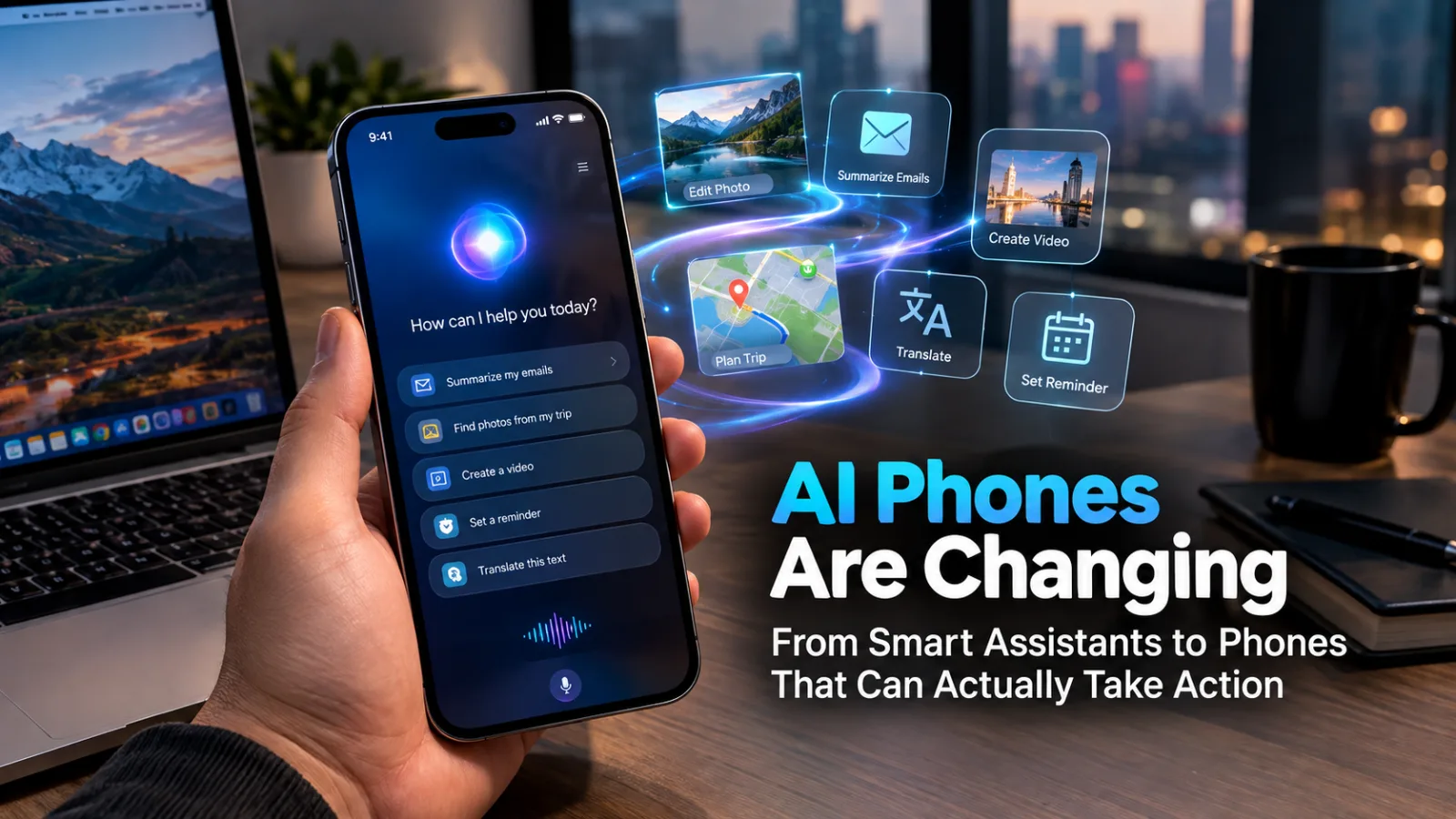
 # AI Phones Are Changing: From Smart Assistants to Phones That Can Actually Take Action
For years, smartphone companies have competed over faster processors, better cameras, brighter displays, and longer battery life.
Now, a different kind of competition is taking over the smartphone industry: artificial intelligence.
AI is no longer limited to a chatbot sitting inside an app. It is becoming part of the operating system, processor, camera, search experience, security system, and everyday workflow of modern smartphones.
The biggest change may be even more important.
Future smartphones may not simply answer questions. They may understand what users are trying to accomplish and perform multiple steps on their behalf.
That shift is already beginning in 2026.
Google is introducing more proactive Gemini capabilities on Android, Samsung is expanding Galaxy AI across its latest devices, and Qualcomm's newest Snapdragon platforms are being designed specifically for on-device and agentic AI experiences.
The result could be a new generation of smartphones that feels less like a collection of apps and more like an intelligent personal assistant.
# What Is an AI Smartphone?
An AI smartphone is not simply a phone with a chatbot installed.
Modern AI phones combine specialized hardware, software, machine-learning models, cameras, sensors, and operating-system features to perform tasks that traditionally required several manual steps.
A conventional smartphone might require a user to open a calendar, search for an event, copy information, open a messaging app, and send it to someone.
An AI-powered phone could potentially understand the user's request and help coordinate those steps.
This is why the smartphone industry is increasingly moving toward what is often called "agentic AI."
Instead of AI only generating an answer, an agentic system is designed to understand an objective, plan actions, use supported tools, and help complete a task.
Google has already demonstrated multi-step Gemini tasks on Android, including workflows where Gemini can interact with supported apps to help complete actions. Availability depends on the device, region, apps, and feature rollout.
# The Processor Is Becoming an AI Engine
One of the biggest changes happening inside smartphones is the growing importance of dedicated AI hardware.
For years, smartphone performance was primarily discussed in terms of CPU and GPU speed.
Today, manufacturers also talk about NPUs and AI accelerators.
These specialized components are designed to handle machine-learning workloads more efficiently than relying only on a general-purpose CPU.
Qualcomm's Snapdragon 8 Elite Gen 5 is a current example of this direction. Qualcomm says its platform combines a 3rd-generation Oryon CPU with a Qualcomm AI Engine designed for personalized agentic AI experiences directly on mobile devices.
This type of hardware can help smartphones perform AI tasks with lower latency and, for supported workloads, without sending every piece of information to a remote server.
That can make AI features feel faster and can also support privacy-sensitive processing.
The important point is that AI is becoming part of the fundamental architecture of the smartphone rather than being treated as an optional application.
# Smartphones Are Starting to Understand Context
One of the biggest limitations of traditional digital assistants is that they often respond to individual commands.
You ask a question, and you receive an answer.
The next generation of AI assistants is trying to understand more context.
For example, imagine receiving a message from a friend asking for photos from your recent trip.
Instead of manually searching your gallery, selecting images, opening the messaging app, and attaching them, an AI system could potentially recognize the request, find relevant photos, and suggest the next action.
Samsung's Galaxy S26 provides an example of this direction with its Now Nudge feature. Samsung says the feature can understand context on the screen and suggest shortcuts for actions such as finding photos or moving information into another app.
This type of contextual assistance could eventually become one of the most important differences between today's smartphones and future AI phones.
# AI Could Change the Way We Use Apps
Apps have traditionally been the foundation of the smartphone experience.
Want to order food? Open an app.
Want to book a ride? Open another app.
Want to edit a photo? Open a photo editor.
Want to summarize a webpage? Copy the text and move it into another tool.
AI could change this interaction model.
Instead of thinking about which app to open, users could simply describe the result they want.
Google has demonstrated multi-step Gemini tasks on Android where the assistant can work with supported applications to help complete activities such as ordering food or arranging a ride. The initial rollout was limited to selected devices, apps, markets, and tasks.
This does not mean every smartphone will automatically perform every task.
Apps still need to support these interactions, and sensitive actions may require confirmation.
But the direction is clear: the user may increasingly interact with the goal rather than the application.
# AI Is Also Transforming Smartphone Cameras
The camera is another area where AI is changing what smartphones can do.
Modern smartphone photography already depends heavily on computational photography.
Instead of simply capturing what the sensor sees, the phone can process multiple frames, analyze lighting, recognize objects, improve details, reduce noise, and adjust colors before producing the final image.
Samsung's Galaxy S26, for example, includes AI-powered Photo Assist features that allow users to describe certain edits using natural language. Samsung also highlights AI-supported camera processing for low-light video and other photography functions.
This could eventually make advanced photo editing much easier.
A user might simply describe an edit instead of learning complicated editing software.
"Remove the person in the background."
"Make the sky brighter."
"Turn this into a professional portrait."
"Improve the lighting."
The phone can then attempt to perform the requested changes.
AI therefore has the potential to turn the smartphone camera into both a recording device and an intelligent editing studio.
# On-Device AI Could Improve Privacy
AI requires large amounts of computing power, but not every task needs to be sent to a cloud server.
Some AI processing can happen directly on the smartphone.
This is known as on-device AI.
There are several potential advantages.
The response can be faster because the phone does not always need to communicate with a remote server.
Certain sensitive information can potentially remain on the device.
And AI features can continue to work in situations where connectivity is limited, depending on the model and task.
Samsung says its Galaxy S26 includes on-device protection features and allows users to control whether certain Galaxy AI processing happens on-device or in the cloud.
Google has also described on-device intelligence as part of its approach to proactive Android AI and security.
However, "on-device AI" does not automatically mean every piece of data is private.
Privacy depends on how a specific feature is designed, what information it processes, what permissions it receives, and whether cloud processing is involved.
# AI Could Make Smartphones More Helpful Without Making Them More Complicated
Technology often becomes more powerful while also becoming more complicated.
AI could potentially reverse that trend.
Instead of adding more menus and settings, intelligent software could hide some of the complexity.
For example, a user may not need to understand which camera mode to choose.
They could simply describe what they want to capture.
Similarly, someone may not need to search through multiple apps to find information.
They could ask the assistant to locate it.
Android 17 is already introducing more AI-powered features, including Gemini capabilities designed to help users with everyday tasks. Google has also described Android's broader transition toward an "intelligence system" with proactive AI assistance.
The goal is not necessarily to give users more technology to manage.
The goal is to make the technology easier to use.
# AI Phones Could Become More Useful for Work
The workplace is another area where AI-powered smartphones could have a significant impact.
A modern phone can already handle email, documents, meetings, messaging, video calls, calendars, and cloud storage.
AI could connect these functions more intelligently.
Imagine finishing a meeting and asking your phone to create a summary, identify the important action items, prepare a follow-up message, and place reminders on your calendar.
Some of these functions already exist individually.
The larger opportunity is combining them into a single workflow.
Google's Gemini Intelligence roadmap for Android includes features intended to automate complex tasks, summarize content, simplify forms, and assist users proactively.
For professionals who use smartphones heavily, this could reduce the amount of time spent switching between applications.
# AI Will Not Replace Every Smartphone Feature
Despite the rapid development of AI, traditional smartphone hardware will remain important.
A powerful AI model still needs a capable processor.
Cameras still require quality sensors and lenses.
Large AI workloads require efficient thermal management and battery technology.
Connectivity remains essential for cloud-based services.
And displays, speakers, microphones, storage, and sensors all contribute to the overall experience.
This means the future smartphone will probably not be "AI instead of hardware."
It will be AI combined with better hardware.
Qualcomm's latest mobile platforms illustrate this approach by combining CPU, GPU, NPU, connectivity, camera capabilities, and AI acceleration into a single mobile platform.
# The Biggest Challenge Could Be Trust
As smartphones become capable of taking more actions, trust becomes increasingly important.
A user might be comfortable asking an AI to summarize a webpage.
But allowing an AI system to send messages, purchase products, access files, or change settings is a different level of responsibility.
Users need to know what the AI is doing.
They should be able to see important actions, stop an automated process, and approve sensitive operations when necessary.
Google has highlighted user control, data protection, and operational transparency as principles for Gemini Intelligence on Android.
This will become increasingly important as AI moves from answering questions to taking actions.
The more capable an assistant becomes, the more important it is that users remain in control.
# What Will the Smartphone Look Like in the Next Few Years?
The smartphone of the near future may still look familiar.
It could still have a large display, multiple cameras, a charging port, speakers, and a powerful processor.
The biggest changes may happen underneath the surface.
The processor could contain increasingly powerful AI acceleration.
The operating system could understand more context.
The camera could automatically edit and enhance content.
The assistant could complete multi-step tasks.
The phone could communicate more intelligently with watches, glasses, cars, earbuds, and other connected devices.
In other words, the physical smartphone may change more slowly than the intelligence inside it.
# The Smartphone Is Becoming an Intelligent Platform
The smartphone industry is entering a new phase.
For more than a decade, improvements were largely measured through faster processors, better displays, improved cameras, and longer battery life.
Those improvements are still important.
But artificial intelligence is changing the way manufacturers think about the device itself.
Today's smartphone is primarily a tool that users operate.
Tomorrow's smartphone could increasingly become a system that understands what the user is trying to accomplish and helps make it happen.
Current products such as the Samsung Galaxy S26, Qualcomm's latest Snapdragon platforms, and Google's expanding Gemini capabilities on Android show that this transition is already underway.
The most important question is no longer simply how powerful a smartphone can become.
It is how intelligently that power can be used.
If the industry succeeds, the next generation of smartphones may not feel like radically different pieces of hardware.
They may simply feel more useful.
And that could be the biggest change of all.